
Luce County MI-VINE Coverage
Michigan calls the service MI-VINE, which stands for Victim Information and Notification Everyday. The official Michigan MI-VINE page describes a free, confidential, round-the-clock source for supported offender and case information. Access is available through VINELink and by telephone at (800) 770-7657. A TTY line is available at (866) 847-1298.
County-jail coverage depends on participating data sources. The research did not confirm Luce County Sheriff or Alger County Jail in the live agency selector, so local coverage must be checked when searching. This is especially important because Luce has a documented contract detention arrangement with Alger. The physical custodian may be Alger even when the arrest or court case began in Luce.
For MDOC prisoners, VINELink provides general release notification. It does not replace OTIS, Michigan's Offender Tracking Information System, for detailed state-prison status and date fields. Federal Bureau of Prisons and immigration custody require their own federal locators. A move from a county jail to one of those systems is a transfer, not a community release.
The state MI-VINE description appears in this captured official page.
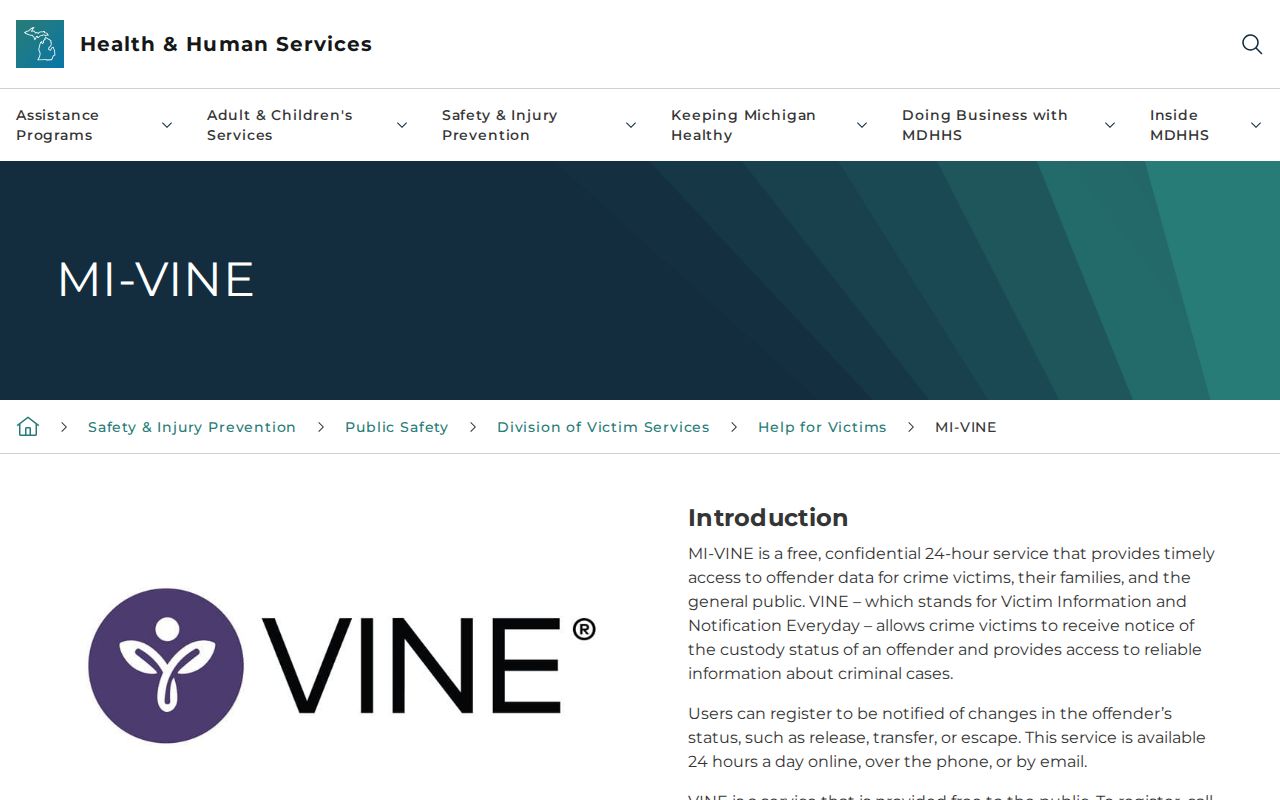
The image identifies the statewide service. Local agency participation still must be verified in the live search.
Search Luce County VINELink Records
Begin with one person and enough identity detail to avoid a false match. VINELink searches should not start with an assumption about the jail. Confirm whether the person was held by Luce, Alger, or MDOC. If an identifier is offered, it is generally more precise than a name alone. Never change real identity details merely to force a match.
- Open VINELink and choose Michigan as the location.
- Select the person or offender search presented by the current interface.
- Enter at least the last name and, when known, the first name. Add a booking or offender identifier when the form offers that field.
- Compare the reporting agency, facility, and all visible identifiers. Luce and Alger are distinct custodians, and the first same-name result may be wrong.
- Open the matching record. Read the current custody information and the supported event or notification choices.
- If the record reports release or out-of-custody status, preserve the agency and event time, then request the agency's release sheet when the destination matters.
- If no match appears, check legitimate spelling and identifier inputs, verify the agency selector, and call MI-VINE. Do not infer release from silence.
The live interface can change. Use labels such as Register, Track, or Notify Me as they currently appear. The Michigan/location search screen shown here illustrates the official entry point rather than a permanent record for any named person.
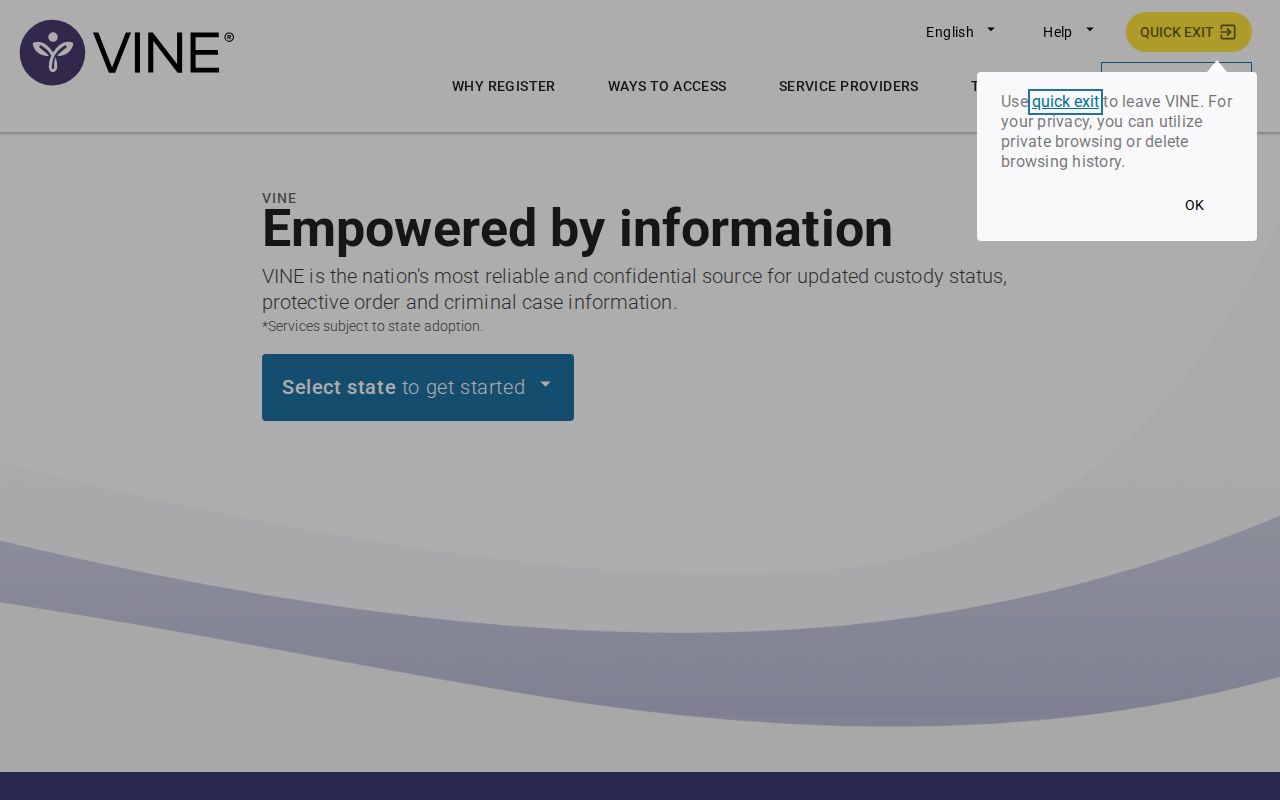
The screen helps locate the search controls. It does not establish Luce or Alger participation by itself.
Luce County VINELink Release Fields
A matching VINELink record should be read as an agency-reported custody event, not as a full release archive. Labels can differ among participating sources. Michigan material supports release, transfer, and escape notifications, but it does not promise one universal “Released” field or a permanent history for every jail.
| Field or action | How to interpret it |
|---|---|
| Name and offered identifier | Match the result to the intended person before reading status. |
| Reporting agency or facility | Shows which participating source sent the event; confirm Luce versus Alger. |
| Custody status | Describes the source's current reported state, subject to update timing and its own labels. |
| Release event | Shows departure from the reporting agency, but not necessarily the destination or end of all custody. |
| Transfer event | Signals movement to another custodian and continued custody. |
| Notification options | Identify the supported phone, text, or email channels for that record. |
A release alert from Alger County Jail means the person left Alger custody. The release sheet must show whether that meant bond, time served, a court-directed community outcome, or pickup by MDOC or another agency. If OTIS later shows “Parolee,” the person left state prison but remains under MDOC supervision. “Discharged” records the end of the relevant MDOC jurisdiction.
Register Luce County Release Alerts
Registration begins from the correctly matched record. It is confidential, and official material says the offender is not told. Choose a contact method that can reliably receive the message. A switchboard or shared number may not work well for an automated call that needs a personal acknowledgment.
- Open the matched record and choose Register, Track, Notify Me, or the equivalent current control.
- Select telephone, text, or email and enter the requested destination.
- For telephone registration, create a four-digit PIN and complete the confirmation.
- When the automated call arrives after an event, listen to the message. Then enter the PIN followed by the number sign to acknowledge it.
- Text and email alerts send a message for a supported change and do not use the telephone PIN.
- If the PIN is forgotten, call (800) 770-7657 and use the operator option. Operators are available at all hours.
Official guidance says calls can continue until the PIN is entered or for up to 24 hours. The acknowledgment stops repeat calls for that event. It does not cancel the need to verify the exit or destination. Check that the registration remains attached to the correct person and agency when custody changes.
Note: A missed alert is not proof that no event occurred; verify registration, source participation, spelling, identifier, and current contact details.
Confirm Luce County VINELink Events
VINELink is a supplemental notification service. It can be fast, but it may lag a participating agency's jail management record. A no-result can reflect spelling, matching, participation, transfer, timing, or retention. It cannot establish that a person has been released. Nor is VINELink a permanent historical archive.
For a Luce county-jail case, first ask Luce Sheriff which facility physically held the person. If Alger was the custodian, ask Alger for the exit date, time, and disposition. Request the booking/release sheet or jail-register entry when a durable record is needed. Check the Luce court for the legal order, remembering that the court timestamp may differ from the actual door time.
For state custody, use MDOC OTIS. Search with the six-digit MDOC number when known, or carefully match a name result. Current Status, Date Paroled, Supervision Discharge Date, and Discharge Date are release-related fields. An Earliest Release Date is only parole eligibility, not proof that the person left prison.
VINELink does not cover federal BOP custody. A federal sentence requires the BOP locator, while immigration detention requires the ICE locator. A person can leave a county jail and enter either system. The Luce County released inmate search provides the full cross-system route when the custodian is uncertain.
Michigan Victim Notice Has Layers
Michigan separates ordinary MI-VINE custody alerts from more detailed MDOC direct-victim notification. VINELink may provide general release, transfer, escape, and other supported alerts for participating county sources and general MDOC release events. It is the right starting point for an event alert tied to a specific searchable record.
Direct crime victims seeking MDOC parole-hearing and decision notices must separately enroll with the MDOC Crime Victim Notification Unit at (877) 886-5401. That program is not replaced by a VINELink registration. The separation is important for a person at Newberry Correctional Facility, which is an MDOC state prison in Luce County rather than a county jail.
The local label can hide three record owners. Luce Sheriff may hold the arrest or commitment file. Alger may hold a contract detainee's physical booking and exit record. MDOC controls prison, parole, and discharge data. Select the notification layer only after identifying which agency holds custody.
- MI-VINE
- Michigan's statewide VINE service for supported information and event notification.
- OTIS
- MDOC's public offender system for covered prisoners, parolees, probationers, and recent discharges.
- Direct-victim notice
- Separate MDOC enrollment for eligible parole-hearing and decision notices.
Note: Participation and interface details are time-sensitive; verify Luce or Alger in the live Michigan agency selector before promising a local alert.
No Luce County VINELink Match
A missing result has several possible causes. The person's name may use a different lawful spelling, the entered identifier may be wrong, or the selected agency may not be the actual custodian. A Luce detainee may be in Alger under the contract arrangement. The source may not participate, an event may still be moving through the data system, or the searchable record may no longer be retained. None of those conditions proves release.
Vary only legitimate inputs. Check the booked spelling, first and last name, date of birth, and an available booking or offender identifier. Call MI-VINE at (800) 770-7657 if the interface does not resolve the search. Then contact Luce Sheriff to identify the physical facility and Alger Sheriff if Alger held the person. Ask whether the named person remains in custody and, if not, whether the exit was a community release or a transfer.
An old MDOC event may fall outside OTIS's public display period. OTIS generally includes people discharged within three years after supervision discharge, while lawful set-aside rules can remove information sooner. For an older state record, ask MDOC Records Retention or use a narrow MDOC records request. A jail-only case will not appear in OTIS at all.
The court can fill part of the chronology. A Luce District Court record may show bond, dismissal, a misdemeanor sentence, or the early stage of a felony. A bound-over felony can continue in Circuit Court. Those entries explain legal action, but they do not replace the physical custodian's exit record.
Keep the wording narrow when a search fails. State that no public VINELink match was located under the checked inputs and agency selection. Then name the next source consulted. That account preserves what was actually checked without turning a database gap into an unsupported custody claim.