
Federal Luce Release Channels
No BOP prison or ICE detention center was found in Luce County during the research. Federal and immigration channels still matter because a person arrested locally can be transferred to federal custody, and a person with a Luce connection can serve a sentence elsewhere. Agency ownership follows the custody, not the home county. A Luce or Alger jail entry that says “released to” a federal agency should be reported as a transfer.
The Bureau of Prisons manages federally sentenced prisoners. ICE handles civil immigration detention and removal operations. The U.S. Marshals Service manages federal pretrial detention and transport, often through contracted local facilities. One locator cannot stand in for the other two. Start with the agency named in the local release or transfer record, federal docket, court paperwork, or known identifier.
| Federal channel | Best public route | What a result can show |
|---|---|---|
| Bureau of Prisons | BOP Inmate Locator | Federal sentence custody, release date, Released or Not in BOP Custody |
| ICE | Online Detainee Locator | Current or recent adult immigration detention, subject to limits |
| U.S. Marshals Service | Federal docket and official inquiry | Pretrial or transport custody; no comparable public history locator |
| Luce or Alger jail | Booking/release sheet | The transfer date and receiving agency |
Search Federal BOP Releases
The BOP Inmate Locator covers federal inmates from 1982 forward. An identification number gives the cleanest search. The system accepts BOP Register, DCDC, FBI, or INS numbers where available. A name search can add age, race, and sex to narrow matches. Compare the register number and biographical details before relying on a result.
- Choose the number search when a federal identifier is known. Otherwise use the exact first and last name with supported details.
- Compare returned name, register number, age, race, and sex. Do not merge people with similar names.
- Read location and release date together. Preserve the exact status wording and date viewed.
- If the result says “Released” or “Not in BOP Custody,” treat it as departure from BOP only.
- Check the federal court record for supervised release and any later custody action. Search ICE if immigration pickup is supported by the record.
A BOP result can list name, register number, age, race, sex, release date, and location. “Released” or “Not in BOP Custody” confirms that BOP no longer holds the person. It does not prove a return to Luce County. BOP cautions that another correctional or criminal-justice agency may hold the person, and court-ordered supervised release may follow imprisonment.
The manifest includes a matching successful capture of the BOP search form.
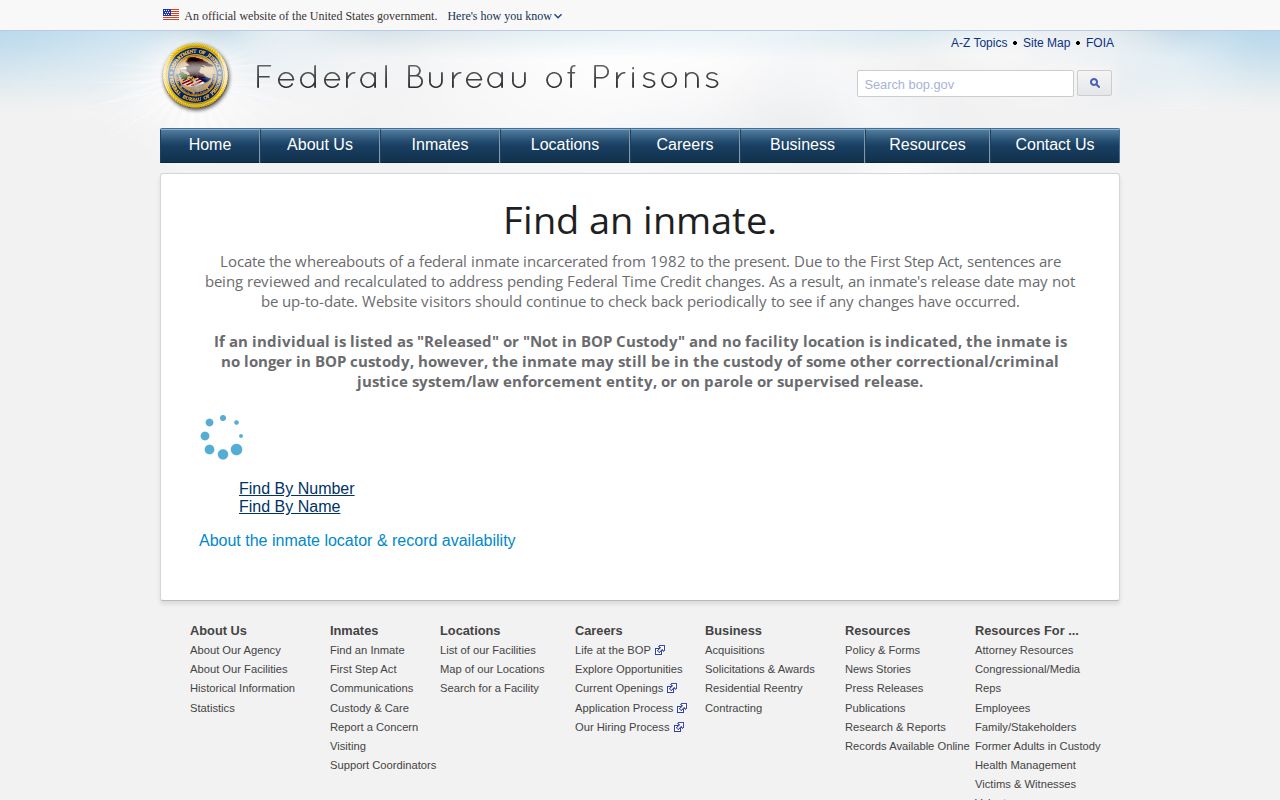
The official federal form illustrates the correct BOP channel; a person-specific result still needs identifiers, status, release date, and a check for later custody.
Search ICE Release Records
ICE’s Online Detainee Locator System is mainly a current or recently released adult immigration-custody tool. It offers two standard search paths. One uses the A-number and country of birth. The other uses first and last name, country of birth, and date of birth. Exact biographical data matters. A no-result can reflect timing, spelling, coverage, a different name format, or a custody change.
ODLS is not a permanent Luce County release archive. If Alger or another local jail records “release to ICE,” that entry documents transfer into continuing immigration custody. Search ODLS, then use the facility or official ICE contact identified by the result. If the person later leaves ICE custody, confirm the event and date through the responsible immigration channel. Do not translate a missing locator result into a claim of community release.
Immigration detention is also distinct from a federal criminal sentence. An INS number used by BOP and an immigration A-number can help identify records, but the systems answer different questions. A BOP release can precede ICE custody. Conversely, an ICE detainee may never have served a BOP sentence. Build the chronology one custodian at a time.
Note: No federal or immigration detention facility was identified in Luce County, so the named receiving agency controls every off-site search.
Find USMS Custody Changes
The U.S. Marshals Service manages federal pretrial detention and prisoner transport. It can place people in contracted local or regional facilities, yet it does not operate a public historical name-based release database comparable to the BOP locator. A jail’s transfer notation, federal docket, attorney, and official agency inquiry are the practical sources during that phase.
Use the federal court docket to identify detention, release, remand, designation, sentencing, and supervised-release orders. Remand means the court sends or keeps the person in custody. A release order provides legal authority, but the physical custodian’s exit record confirms when the person actually left. A designation to federal prison shifts the public search toward BOP once intake data appears.
If a local record names USMS but not the next facility, ask the jail for the transfer document and ask the appropriate official channel about current location. A Marshals pickup is not a community release. The person can be outside Alger County Jail while still fully confined under federal authority.
Luce Federal Transfer Records
A Luce County arrest may generate records in Luce even when Alger physically houses the detainee. If a federal agency later takes custody, the full path can involve the Luce Sheriff, Alger County Jail, Luce court, federal court, and receiving federal agency. Each office records a different part. No single “Luce inmate search” can replace that chain.
Ask Luce for the arrest, warrant, commitment, or local administrative record. Ask Alger, when it was the physical jail, for the booking/release sheet, exact exit timestamp, and receiving-agency notation. Ask the court for the legal disposition. Then use BOP, ICE, or the federal docket based on that notation. The Luce County released inmate search covers the local first steps in detail.
When dates differ, do not force them to match. A court order, jail exit, Marshals pickup, BOP intake, and database update can occur at separate times. Record each event with its source and label. The jail’s physical exit answers when Alger custody ended. The receiving record answers what custody followed.
Federal Release Date Changes
A BOP release date can change due to sentence recalculation and earned or applied First Step Act credits. A projected date should therefore be read as the date the official system currently shows, not as an irrevocable promise. For a past event, preserve the release status and date shown after the event and compare them with the federal docket when exact legal terms matter.
Supervised release is a court-ordered period after federal imprisonment. It is not BOP prison custody, but it is not the same as having no federal obligations. Revocation can lead to a later custodial event. Report “released from BOP custody” separately from “completed supervised release” unless the court record supports both.
ICE results have a different timing problem. The locator is oriented to current and recent detention and can lag. It may not retain a convenient historic release entry. Keep any agency-provided event and facility details, then request confirmation through the official channel if a stable record is required.
Federal Release Record Routing
There is no single Luce County contact card for this channel because no local federal or ICE facility was identified. The correct contact is the agency and facility named in the controlling record. For BOP, begin with the locator and the listed institution or BOP record route. For ICE, begin with ODLS and the office or detention site it identifies. For USMS pretrial custody, use the federal case and the responsible district or official inquiry route.
Federal release lookup starting pointsBOP Inmate Locator: bop.gov/PublicInfo/execute/inmateloc
ICE Online Detainee Locator: locator.ice.gov/odls
USMS phase: federal docket and official agency inquiry
Local transfer record: Luce Sheriff or Alger County Jail
Use a narrow request. Ask for a named existing document, such as the local transfer record, federal release computation, or custody-history entry. Include the exact name, date of birth, identifier, case number, and approximate dates. Broad questions invite routing problems, while a specific record lets the agency confirm whether it is the custodian.
Luce Contract Custody and Federal Release
The documented Luce and Alger arrangement adds one more handoff to a federal case. A person can start with a Luce arrest, be booked and held in Munising, then leave Alger for USMS or ICE custody. The phrase “released from Alger” would be technically true about that one jail but misleading about overall confinement. The disposition turns it into a transfer record.
Confirm current arrangements because the contract can change and does not prove every placement. A federal or immigration destination should come from the actual release or transfer entry, not a guess based on a missing local name. The physical custodian supplies the exit event. The receiving sovereign supplies the next status.
- BOP release
- Departure from Bureau of Prisons custody, possibly followed by supervision or another agency.
- ICE transfer
- Movement into immigration custody, not community release.
- USMS custody
- Federal pretrial or transport custody without a broad public history locator.
- Supervised release
- Court-ordered federal supervision after imprisonment.
Federal Versus Luce Release Records
Luce County has two prominent local or state paths: contract county detention and the MDOC-run Newberry Correctional Facility. Federal records form a third branch even though no federal facility was found locally. County jail departure uses the physical jail’s exit sheet. NCF parole or discharge uses OTIS and MDOC. BOP, ICE, and USMS each require their own federal route.
Always name the agency in the final statement. “Released from BOP custody,” “transferred from Alger to ICE,” and “paroled from Newberry Correctional Facility” describe three different outcomes. Clear labels preserve what each source proves and prevent geography from hiding continuing custody.