
Michigan Corrections Release Records
The Michigan Department of Corrections is a statewide prison, parole, and felony probation system. Its public Offender Tracking Information System, known as OTIS, includes current prisoners, parolees, and probationers under supervision. It also includes people discharged within three years of supervision discharge, subject to statutory and system limits. A Luce County connection may come from the sentencing court, assigned supervision office, or incarceration at Newberry Correctional Facility. None makes MDOC a county jail.
MDOC uses separate status terms for separate events. A parolee has physically left prison but remains in MDOC legal custody and supervision. A probationer is serving a community sentence and may never have entered state prison. A discharged person has reached the end of the relevant MDOC jurisdiction. A prisoner remains in state custody. Read sentence-level details because a person can have several active and inactive cases.
| Status or date | What the record means | What it does not prove |
|---|---|---|
| Parolee / Date Paroled | Physical prison release into supervision | Final discharge from MDOC |
| Probationer | Community supervision under a court sentence | A prior state-prison stay or jail exit date |
| Discharged / Discharge Date | Relevant MDOC jurisdiction ended | That every other case or agency hold ended |
| Prisoner | Current MDOC custody | Community release |
| Earliest Release Date | Board jurisdiction or parole eligibility | An appointment for release |
Search Michigan Corrections Releases
Use the official OTIS search. A six-digit MDOC number is the most precise key. If it is unavailable, enter last and first name, then compare identifiers and court information. Same-name matches must not be merged. Save the date viewed because statuses and calculated dates can change as MDOC or a court updates the file.
- Enter the MDOC number, or search by name with enough details to narrow the results.
- Read status and assigned location in the result list. A prisoner result is not a release.
- Open the profile and compare MDOC number, State Identification number, demographic description, sentencing county, court file, and offense data.
- Read Current Status, active and inactive sentence blocks, Date Paroled, supervision dates, Discharge Date, and Discharge Reason.
- Separate past event fields from Earliest Release Date and Maximum Discharge Date. Those future or computed fields cannot confirm departure.
- If the result is absent or too old, request the identified release or discharge record from MDOC and check the sentencing court.
The OTIS definitions page explains status and date vocabulary. “DISCHRG” means the person is no longer under MDOC jurisdiction for the sentence. A profile may show a top-level discharge, inactive sentences, sentence-specific discharge dates, and reasons. These fields are stronger evidence than a result with no active sentence read in isolation.
Michigan Corrections Search Fields
A full OTIS profile can display far more than a release event. Keep the status analysis focused. The MDOC number, State Identification number, name, aliases, image and image date, physical description, identifying marks, status, assigned location, security level, and sentence blocks help confirm identity. Release-specific fields then explain the custody timeline.
| Field | Use in a release check |
|---|---|
| Current Status | Separates prisoner, parolee, probationer, and discharged records |
| Date Paroled | Shows physical prison release into parole |
| Supervision Begin Date | Marks the start of community supervision |
| Supervision Discharge Date | Shows when the supervision term ended or is expected to end, as labeled |
| Discharge Date and Reason | Documents the end and basis of relevant MDOC jurisdiction |
| Assigned location | Identifies prison or parole/probation office, depending on status |
| Active/inactive sentences | Prevents one completed sentence from hiding another active one |
OTIS may show an MDOC image, but it is not necessarily a Luce or Alger booking photograph. Some older records lack a digital image. The photograph cannot prove the date or legal basis of release. Use it only as one identity clue, then rely on the dated status fields and underlying records.
The manifest includes a successful capture of the OTIS search form.
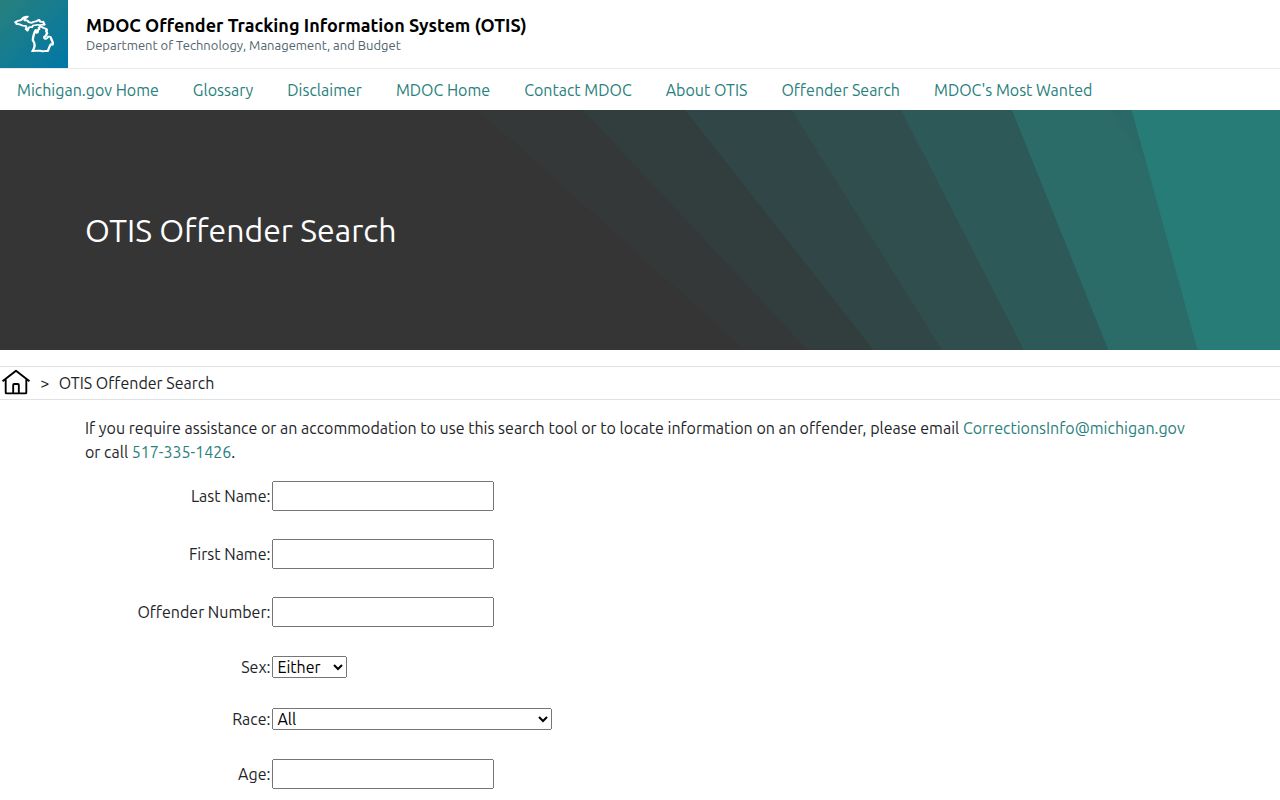
The official form shows the proper statewide search channel; it does not itself establish a person’s released or discharged status.
Michigan Corrections Records Contact
When OTIS does not retain the needed record, request a specific item through the MDOC FOIA process. MDOC’s public window generally ends three years after supervision discharge. A conviction set aside by a court or operation of law can remove a public result sooner. A missing profile therefore does not prove that no MDOC history exists. The sentencing court and MDOC records channels may still establish the chronology, subject to lawful access limits.
MDOC FOIA CoordinatorP.O. Box 30003
Lansing, MI 48909
Phone: (517) 335-4194
Fax: (517) 335-4193
Email: MDOC-FOIA@michigan.gov
Ask for a release or discharge certificate, parole order or decision, sentence computation, chronological history, relevant dates and status, or an available offender photo. Include the full name, birth date, and six-digit MDOC number. Current-prisoner records may be directed to Corr_Records_Info@michigan.gov. Past-prisoner records up to six years post-release may be directed to MDOC-Records_Retention@michigan.gov.
MDOC says computerized records reach back to about 1980 and points older requests to the Archives of Michigan at archives@michigan.gov. A PENPACK is not a general public shortcut. MDOC describes it as a packet of certified corrections items restricted to recognized criminal-justice authorities for official work.
Michigan Corrections Release Dates
Michigan does not use “projected release date” as its main OTIS label. Earliest Release Date, also called the Parole Board Jurisdiction Date in the system’s explanation, is when the Board first gains authority. It is not a promise. The Board may deny parole and reconsider the person later. A past ERD with a current “Prisoner” status does not support a release claim.
Maximum Discharge Date is a potential sentence endpoint under the lawful calculation. It can change due to consecutive or new sentences, misconduct, court corrections, lawful credits, parole violations, or recalculation. For covered offenses, Michigan truth in sentencing generally requires service of the full judicial minimum, not a generic 85 percent formula. MCL 791.234 governs Board jurisdiction, while MCL 800.33 and 800.34 address different credit and disciplinary-time frameworks.
The event field controls a past release. Date Paroled confirms physical prison departure into continuing supervision. Discharge Date confirms the later end of the relevant MDOC jurisdiction. A county jail exit date answers a different question and must come from the physical jail record.
MDOC Releases from Newberry
Newberry Correctional Facility is the key state institution physically located in Luce County. It is a Level I adult male prison, not a county detention center. The facility page states that it opened in 1996 and has 1,108 beds. Programs, security level, and capacity do not predict one person’s release. OTIS, the Parole Board process, and MDOC records supply the person-specific answer.
A person can parole from NCF to a supervision office outside Luce County. Geography does not dictate the destination. If OTIS displays an assigned office, that is the correct supervision contact, subject to confidentiality rules. The Luce parole/probation office at 407 W. Harrie Street is a local channel only when the profile or agency actually assigns the case there.
Errors in court-derived OTIS fields should first be addressed to the sentencing court. Supervision-related errors go to the assigned parole or probation office. MDOC states that corrections can follow a court order or supervising-agent direction. General concerns can be sent to correctionsinfo@michigan.gov.
Luce Contract Records Before MDOC Release
An official 2024 packet documents approval of a 12 to 14 bed detention contract between Luce and Alger counties. That local arrangement is separate from MDOC, yet it can be the first part of a later state-prison chronology. If Alger’s exit record says the person was transferred to MDOC, the county jail custody ended while state custody began. The local entry is not a community release.
Ask Luce for the arrest or commitment record and Alger for the physical exit and transfer entry. Then search OTIS for the state intake, status, and later parole or discharge. Current placement should still be confirmed because the contract does not prove that every Luce detainee is always held at Alger. Keeping each event under its creating agency prevents the local handoff from being confused with the much later MDOC release.
MDOC Versus Luce Jail Releases
Luce County’s mix of a small sheriff operation, cross-county detention, and Newberry Correctional Facility makes custodian identification essential. A county detainee may physically exit Alger County Jail in Munising. An MDOC prisoner may leave NCF on parole. The county event belongs to the jail release sheet and court record. The state event belongs to OTIS and MDOC.
If a jail transferred someone to MDOC, the jail exit is not community release. It is the start of the state custody branch. If an OTIS parolee has left prison, county roster absence adds nothing. The Luce County release search lays out the full custody-first route when the responsible system is unknown.
- Parole
- Prison release with MDOC supervision continuing.
- Probation
- A court-ordered community sentence that need not follow prison.
- Discharge
- The end of the relevant MDOC authority.
- Absconder
- A supervised person who failed to remain where required, not a lawful discharge.