
Luce County Parole Versus Probation
Parole and probation both place a person in the community under rules, but they begin in different ways. Parole follows release from an MDOC prison. The Michigan Parole Board authorizes that release, and MDOC retains legal control during the parole term. Probation is imposed by a court and can follow a county case without any state-prison stay. An OTIS status of “Probationer” therefore does not prove that the person was released from Newberry Correctional Facility, Alger County Jail, or any other jail.
The distinction controls what a record can establish. A “Parolee” status paired with a Date Paroled confirms physical departure from state prison into supervision. A probation start date identifies community supervision, but the Luce or Alger release sheet is still needed to prove a jail exit. “Discharged” means MDOC jurisdiction ended for the relevant status or sentence. Multiple sentence blocks can have different dates, so the current status and each active or inactive sentence should be read together.
| Feature | Parole | Probation |
|---|---|---|
| How it begins | Michigan Parole Board grants release from state prison | A court orders community supervision |
| What it proves | Date Paroled can confirm departure from prison | Probation status does not prove a prior prison stay |
| Public check | OTIS current status, parole date, and assigned location | OTIS status plus the sentencing court record |
| How it ends | MDOC supervision discharge or other lawful disposition | Court or MDOC supervision discharge, depending on the case |
- Parole
- Conditional release from state prison while MDOC legal custody and supervision continue.
- Probation
- Court-ordered community supervision that may occur without a state-prison sentence.
- Discharge
- The end of MDOC jurisdiction for the status or sentence shown.
- Absconder
- A supervised person who failed to remain where required and is being sought.
Verify Luce County Post-Release Supervision
Michigan OTIS is the first public check for state parole and felony probation. It covers current MDOC prisoners, parolees, and probationers, as well as people discharged within the public display window. It does not cover a person serving only a county-jail sentence. Search by the six-digit MDOC number when it is known. A name search is less exact, so matching the date of birth, description, sentencing county, court file, and sentence details is essential.
- Open OTIS and enter the six-digit MDOC number, or use the person’s first and last name.
- Compare identifiers before opening a profile. A same-name result from another county is not a match.
- Read Current Status first. “Parolee,” “Probationer,” “Prisoner,” and “Discharged” answer different questions.
- Review Date Paroled, Supervision Begin Date, Supervision Discharge Date, assigned location, and all sentence blocks.
- Check the Luce court record when probation or the sentence origin matters. A court entry explains the order, while OTIS describes MDOC supervision.
- Contact the assigned office about a supervision-location issue or possible error. Use the jail record for a jail-only release date.
An OTIS profile can also show an Earliest Release Date or Maximum Discharge Date. Those are not proof of a past exit. The Earliest Release Date marks when the Board first gains jurisdiction, while the maximum date is a potential sentence endpoint. Date Paroled is the release-event field for parole. A discharge date documents the later end of jurisdiction. The full Luce County released-inmate search explains how to pair these fields with county and court records.
Luce County Supervision Office
Luce County has a dedicated MDOC parole and probation office in Newberry. That local office is a useful contact when OTIS lists Luce as the assigned supervision location, when a reporting jurisdiction needs clarification, or when a supervision-related field appears wrong. Confidentiality rules can limit what staff will disclose. The office is not the correct line for a person whose case involved only county detention and no MDOC supervision.
Luce County Parole/Probation407 W. Harrie Street
Newberry, MI 49868
(906) 293-8471
The official MDOC Region 1 office directory shows the Luce office and its local contact details.
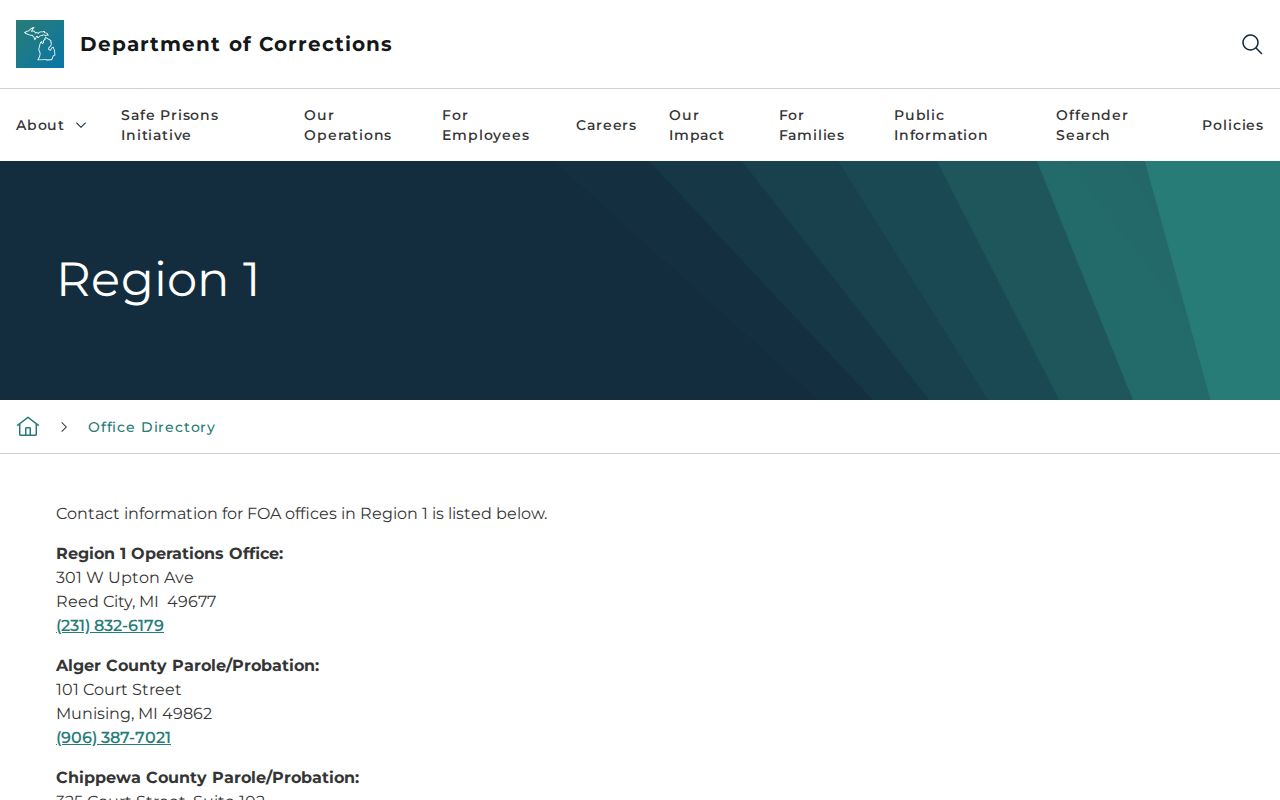
The directory image helps confirm the correct local office, but an office listing alone does not prove that a named person is supervised there.
Luce County Release Supervision Channel
The Newberry office is a distinctive local path because Luce County release questions can cross several agencies. A person arrested in Luce may have been physically held and released by Alger County Jail under the documented contract arrangement. Another person may leave Newberry Correctional Facility on parole. Both events have a Luce connection, yet only the state-prison release belongs in MDOC parole records.
Start with the custodian. For a Newberry Correctional Facility case, use OTIS and the local supervision office. For a jail-only Luce case, call Luce Sheriff and ask which facility held the person. If Alger held the person, Alger’s exit record controls the physical departure. Probation may begin after that county release, but the probation record cannot replace the jail’s release date and disposition.
This split also affects corrections. MDOC directs supervision-related OTIS issues to the appropriate parole or probation office. Court-derived errors should first go to the sentencing court. A Luce or Alger booking error belongs with the agency that created that record. Naming the field and its source keeps each correction request narrow.
Note: The Luce supervision office can clarify an assigned MDOC location, but it does not verify release from a county jail.
Luce County Supervision Status Changes
Conditions are rules attached to community supervision. The precise terms come from the parole order, probation order, supervising agent, and applicable law. Public records may show the broad status, office, and dates without disclosing each instruction. A violation allegation does not itself establish the final result. The supervising authority and court or Board record must show whether supervision continued, changed, or ended.
A parole grant is also not immediate proof of release. The Michigan Parole Board decides whether parole may begin, and a grant passes through the Parole Release Unit before physical departure. Adverse information or misconduct can affect a pending release. Once the person leaves prison, a later violation may lead to arrest or revocation proceedings. Current Status and Date Paroled remain the key public fields for deciding whether the prison exit occurred.
Probation follows the sentencing court’s order. A violation can lead to a hearing and a new court disposition. When MiCOURT displays the case, its Register of Actions can help identify filed events, but the online view is informational. The clerk’s record controls. For a supervision question, compare the court case with OTIS rather than treating one system as a complete history.
Luce County Absconder Record Meaning
An absconder status requires care. MDOC explains that a parole absconder failed to remain where required and is actively sought. A probation absconder remains under the sentencing county’s jurisdiction. Physical absence from an institution is not lawful discharge. It would be wrong to read an absconder label as proof that supervision ended.
Information about an absconder’s location should go to local law enforcement or the MDOC Absconder/Escapee Tip Line at (517) 755-0855. The Luce supervision office can address routine office or record questions, subject to its limits. Do not use MI-VINE as a substitute for the controlling supervision record. VINE is built for supported custody-event notices and may depend on agency participation.
A warrant or violation can also explain why dates change. Read the profile’s current status, assigned office, active sentences, and discharge fields as one record. If a date or status seems inconsistent, note when the profile was checked and ask the proper office about that exact field. Broad assumptions create more error than a narrow, dated inquiry.
Note: “Absconder” signals unresolved supervision, not release from MDOC authority and not successful completion of parole or probation.
Luce County Supervision Discharge Records
Supervision ends through a recorded discharge or another lawful case disposition. OTIS defines discharged status as no longer under MDOC jurisdiction for the sentence shown. A profile may contain a top-level discharge date, supervision discharge date, inactive sentence blocks, and a reason. Review all of them when the person has more than one case. One completed sentence does not prove that every active matter ended.
Michigan keeps qualifying discharged-offender information on public OTIS for three years after supervision discharge under the MDOC publication framework described in its official materials. A set-aside can remove or suppress public information earlier. If the result no longer appears, the absence does not establish that no supervision record existed. A narrow request to MDOC Records Retention, MDOC FOIA, or the sentencing court may be needed, subject to lawful access limits.
For date-specific parole questions, the MDOC Parole Release Unit accepts an inquiry with the prisoner’s name or number and requester contact details. That channel concerns a state-prison parole release. A Luce or Alger jail exit still must be confirmed by the physical jail custodian. Keeping those records separate produces a clear chronology: jail or prison departure, supervision start, status changes, and final discharge.