
Luce County Projected Versus Actual Release
A projected date is a future eligibility point or sentence endpoint calculated from the governing judgment and corrections rules. It can change. An actual release date records an event that has occurred. For an MDOC prisoner, Date Paroled can show departure from prison into community supervision. A Discharge Date can show the end of MDOC jurisdiction. For a Luce county detainee who may be housed at Alger County Jail, the physical custodian’s exit record is the strongest proof of departure.
A pretrial detainee does not have a sentence-based release date. Release may depend on bond, a court order, dismissal, another warrant, or transfer. Even after a court acts, jail processing and outside holds can affect the actual exit. A sentenced county-jail detainee has a court commitment, but no current Luce or Alger public computation policy was found. The jail and court must provide the sentence calculation and event record.
Transfer is another key limit. A person can leave Alger County Jail for MDOC, federal, immigration, or another county custody. That is an exit from one facility, not release to the community. The record must state the disposition or destination before the event is described as a community release.
Find a Luce County Projected Date
Begin by identifying the custodian. OTIS applies to MDOC state prisoners and people under felony parole or probation. It expressly excludes county jail-only cases. A Luce arrest may lead to contract detention at Alger County Jail, so a local case can require both sheriff offices and the Luce court. Federal and immigration cases use separate systems and must not be forced into a Michigan date field.
- Determine whether the person is held by Luce or Alger, an MDOC prison, BOP, ICE, or another agency.
- For an MDOC prisoner, open OTIS and search by the six-digit MDOC number when known.
- Match the profile using the name, identifiers, sentencing county, court file, offense data, and current location.
- Read Current Status before any date. Then review Earliest Release Date, Maximum Discharge Date, active sentences, and any parole or discharge fields.
- For a county-jail sentence, obtain the actual court commitment and ask the physical jail custodian for its written calculation.
- Near the expected event, confirm again with the releasing agency. A future date may have changed since the last check.
The Luce County release-record search provides the broader path when custody is unclear. It routes a jail-only case to Luce and Alger, a prison case to MDOC, and a federal or immigration matter to the proper locator. This classification step prevents an OTIS no-result from being misread as proof of release.
Note: A “Prisoner” current status remains a custody signal even when an Earliest Release Date has already passed.
Luce County ERD and Maximum Dates
Michigan OTIS uses specific terms. “Projected release date” is not its main label. The two future-facing fields are Earliest Release Date and Maximum Discharge Date. The official search definition also calls the earliest date the Parole Board Jurisdiction Date. That is when the Board first gains authority to consider parole, not an appointment for release.
| OTIS field | What it means | What it does not prove |
|---|---|---|
| Current Status | Whether the person is shown as prisoner, parolee, probationer, or discharged | A status should not be read apart from sentence details |
| Earliest Release Date | First Parole Board jurisdiction or eligibility point | It does not promise release on that date |
| Maximum Discharge Date | Potential sentence endpoint under the applicable calculation | It is not proof of a completed discharge |
| Date Paroled | Recorded departure from prison into parole supervision | Parole does not end MDOC authority |
| Discharge Date | Recorded end of MDOC jurisdiction for the relevant status or sentence | One sentence entry may not resolve every case |
The official OTIS definitions page explains this date vocabulary.
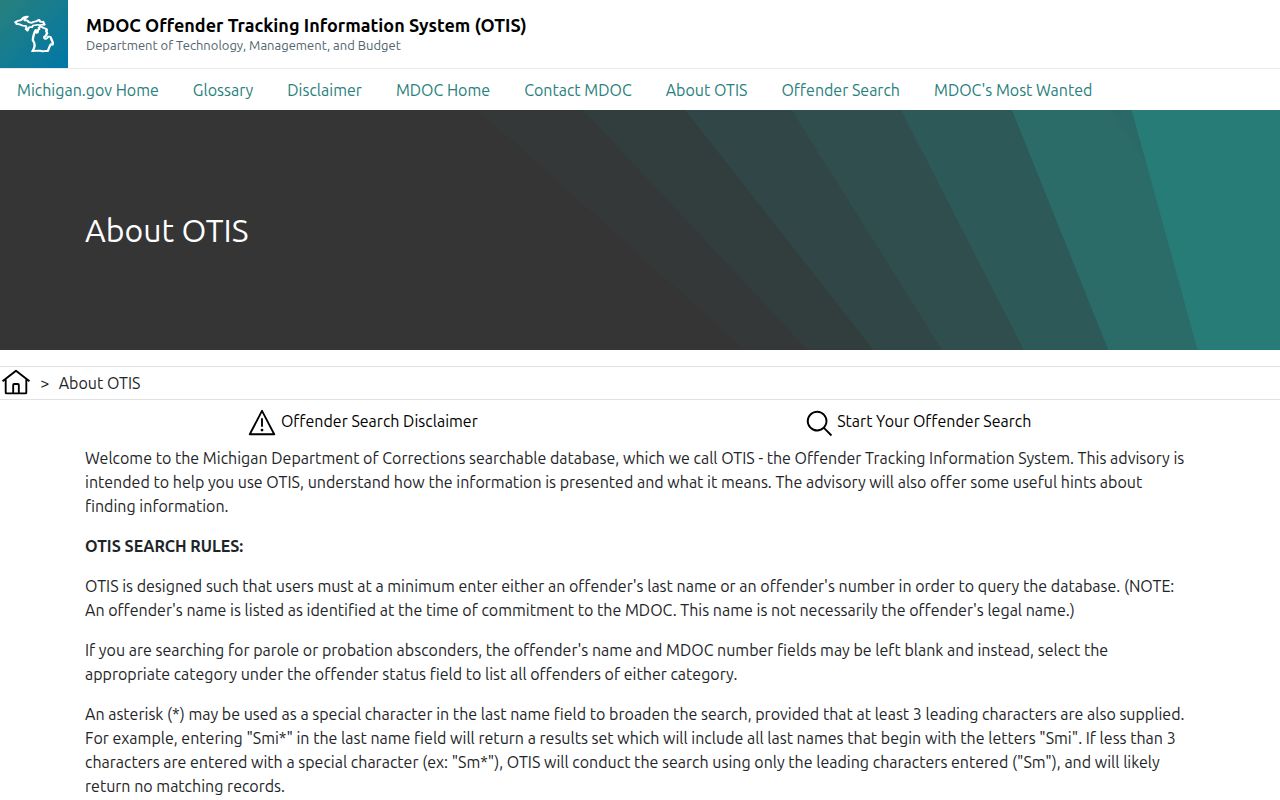
The definition screen shows why eligibility fields must be separated from past-event fields when confirming a Luce County release.
The two future dates serve different planning needs. The Earliest Release Date marks the first point at which the Board may act in an eligible case. A denial can leave the person confined beyond that date and lead to later reconsideration. The Maximum Discharge Date points toward the potential sentence endpoint under the lawful calculation, but later credit decisions, misconduct, consecutive terms, or record corrections can alter it. Neither field answers whether release occurred.
Michigan’s vocabulary also prevents a false percentage shortcut. The Earliest Release Date for a covered truth-in-sentencing case reflects the full judicial minimum, not a generic estimate based on serving about 85 percent. The person’s offense date, sentence, and active terms govern. Reading the OTIS label with the current status and sentence blocks is more accurate than converting the judicial term into an unsupported fraction.
Past-event fields settle a different question. Date Paroled records prison departure into MDOC supervision. Discharge Date records the end of the relevant MDOC jurisdiction. For a jail-only Luce County sentence, neither OTIS future date applies. The Luce court commitment and the physical custodian’s computation must be used instead.
Luce County Truth-in-Sentencing Dates
Michigan should not be described with a generic 85 percent rule. For covered cases, Michigan truth in sentencing generally requires service of the full judicial minimum in prison. MDOC states that the framework applies to specified assaultive crimes committed on or after December 15, 1998, and all other crimes committed on or after December 15, 2000. The sentence and offense date determine which rules apply.
MCL 791.234 addresses Parole Board jurisdiction and distinguishes prisoners subject to disciplinary time from older credit-eligible cases. A covered prisoner does not earn credits that reduce the judicial minimum. Misconduct can add disciplinary time within the statutory framework, but the minimum-plus-disciplinary-time treatment cannot be summarized as an automatic percentage.
MCL 800.34 governs disciplinary time for truth-in-sentencing prisoners. It permits Board consideration within the governing structure and bars minimum plus disciplinary time from exceeding the maximum. The statute should be read with the judgment, sentence entries, and OTIS profile. A single future date never replaces the complete record.
This framework is especially important for Newberry Correctional Facility. NCF is an MDOC state prison located in Luce County. Its prisoners use statewide MDOC sentencing and parole rules, not a Luce County jail formula. The geographic location does not change the legal custodian.
Luce County Legacy Credit Calculations
Older Michigan sentences may follow legacy good-time or disciplinary-credit rules. MCL 800.33 contains the older schedules. It includes pre-April 1, 1987 good-time amounts and, for certain eligible later cases, generally five days of disciplinary credit per month plus possible special credit. Misconduct can affect those credits.
The Maximum Discharge Date can reflect the applicable statutory calculation. MDOC explains that a warden’s later credit determination may affect the maximum date for a credit-eligible person. Consecutive sentences and corrections to the sentence record can also change what OTIS displays. That is why an older case should be reviewed by sentence block rather than reduced to one statewide formula.
Eligibility for a legacy credit is a legal and record-specific issue. Use the offense date, sentence date, judgment, and MDOC computation. Do not apply a legacy schedule merely because an OTIS profile contains a maximum date. A narrow MDOC records request can seek the sentence computation or chronology when the public profile lacks enough detail.
Note: Michigan’s older credit statutes are not a substitute for the current calculation maintained for the named prisoner.
Luce County Jail Release Computation
County-jail sentences use a different path. MCL 51.282 authorizes a county framework for recording infractions and reducing a sentence for good behavior. No current Luce or Alger published computation policy was located in the research. It would be inaccurate to apply MDOC Earliest Release Date, truth-in-sentencing, or legacy prison-credit formulas to a jail-only sentence.
Ask for two records. The court commitment states the sentence imposed and may show credit the court awarded. The physical jail custodian’s computation shows how it administered the term. Because Luce has a documented contract arrangement with Alger, first ask the Luce Sheriff where the person is held. If Alger is the custodian, ask Alger for the calculation and actual release record.
A detainee awaiting trial has no good-time projection based on a sentence that does not yet exist. Bond, dismissal, a plea, a sentence, another warrant, or a transfer may determine the next event. The Luce 92nd District Court handles misdemeanor outcomes and early felony stages, while a bound-over felony proceeds in the 11th Circuit record. Court entries explain legal authority, but the jail exit record confirms the door time.
Why Luce County Release Dates Change
A displayed date can move for more than one reason. The cause should be tied to the agency and sentence involved. An MDOC recalculation affects a state-prison profile. A Luce or Alger jail computation affects a county sentence. A court correction can reach either system after the custodian receives and applies the order.
| Factor | Possible effect | Best confirmation |
|---|---|---|
| Misconduct or disciplinary time | May affect the applicable prison calculation | MDOC sentence computation and OTIS |
| Legacy credits | May change a credit-eligible maximum date | MDOC calculation under the governing statute |
| Consecutive or new sentence | Can extend or recalculate the custody period | Court judgment and active sentence blocks |
| Court correction | Can alter a term, credit, or controlling date | Certified court order and updated custodian record |
| Parole decision | A denial keeps the person confined; a grant begins release processing | Board record, Date Paroled, and exit record |
| Violation or revocation | Can change custody and later discharge timing | Current OTIS status and Board or court record |
| Detainer or transfer | Can prevent community release after one agency’s exit | Release disposition and receiving-agency record |
Close to a projected event, recheck the record. A VINELink release check may provide a supported notification if the reporting agency participates, but it is a supplemental event service, not a permanent date archive. Confirm the event with MDOC or the physical jail custodian and preserve the source and check date.
The final wording should be precise. “Eligible for parole” means the Board may consider release. “Parole granted” means the decision moved into release processing. “Date Paroled” confirms the prison departure into supervision. “Discharged” documents the end of the relevant MDOC jurisdiction. “Released from Alger custody” needs a disposition before anyone can say the person returned to the community.